How Does 6063 Aluminum Improve Heat Sink Performance?
6063 aluminum is widely used in heat sink manufacturing because of its thermal conductivity, extrusion performance, corrosion resistance, and surface finish quality. In this article, we explain how 6063 aluminum improves heat sink performance, what factors affect heat dissipation, and how extrusion, CNC machining, and surface treatments influence the final radiator assembly.
Table of Contents
- Why Is 6063 Aluminum Used in Heat Sink Manufacturing?
- How Does 6063 Aluminum Improve Heat Sink Performance?
- Which Design Factors Affect Aluminum Heat Sink Efficiency?
- How Are 6063 Aluminum Heat Sink Profiles Manufactured?
- How Does Surface Treatment Affect Heat Sink Performance?
- Where Are 6063 Aluminum Heat Sinks Used?
- How Does Aluassy Support Custom Heat Sink Production?
- Frequently Asked Questions
Why Is 6063 Aluminum Used in Heat Sink Manufacturing?
When selecting aluminum for a heat sink, we look beyond the material name. Thermal conductivity, extrusion performance, mechanical strength, corrosion resistance, and dimensional stability all influence the final product. Among commonly used aluminum alloys, 6063 is a practical choice for heat sink profiles because it combines good thermal performance with excellent formability.
6063 aluminum belongs to the Al-Mg-Si alloy series. Its composition makes it suitable for extrusion processes, allowing manufacturers to produce complex cross-sections with multiple fins, grooves, and mounting structures. These features are important because a heat sink needs sufficient surface area and an appropriate structure to transfer heat into the surrounding air.
Compared with materials that are difficult to extrude into detailed profiles, 6063 aluminum offers greater flexibility in profile design. Manufacturers can adjust fin height, spacing, base thickness, and overall dimensions according to the thermal and installation requirements of different applications.
| Material Property | 6063 Aluminum Characteristics | Value for Heat Sink Production |
|---|---|---|
| Thermal Conductivity | Approximately 200 W/(m·K), depending on temper and material condition | Transfers heat from the base toward the fins |
| Extrusion Performance | Good formability and extrusion characteristics | Supports complex fin and profile structures |
| Corrosion Resistance | Good natural corrosion resistance | Suitable for long-term use in various environments |
| Surface Finish | Suitable for anodizing, powder coating, and polishing | Provides different appearance and protection options |
| Mechanical Properties | Available in different tempers, including T5 | Balances structural strength and manufacturing requirements |
These characteristics make 6063-T5 aluminum a common option for extruded heat sink profiles. However, alloy selection should still be based on operating temperature, heat load, profile dimensions, and mechanical requirements rather than assuming that one alloy fits every cooling application.
How Does 6063 Aluminum Improve Heat Sink Performance?
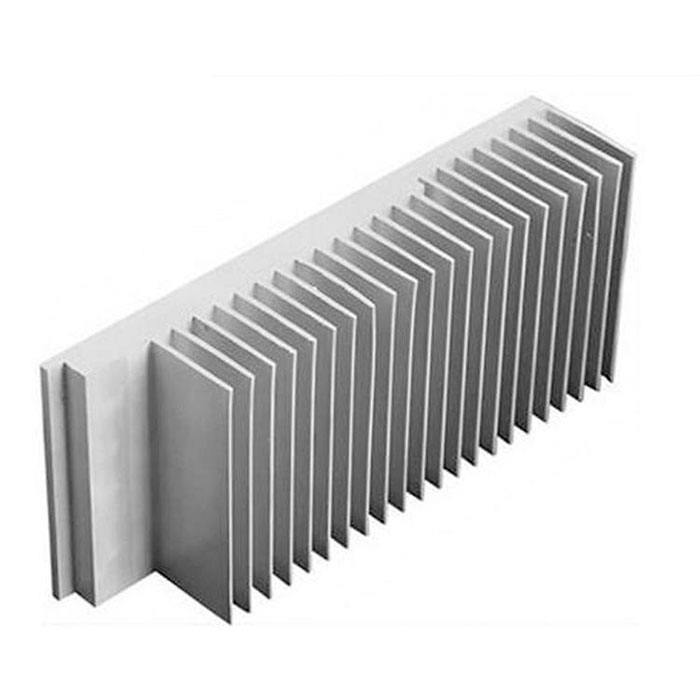
A heat sink works by receiving heat from an electronic component or another heat source, spreading that heat through its aluminum base, and transferring it into the surrounding air through the fins. The material and structural design work together. Good thermal conductivity helps distribute heat, while an effective fin structure increases the available surface area for convection.
1. Efficient Heat Transfer Through the Aluminum Base
The base of a heat sink is the first major heat transfer path. When a component generates heat, the aluminum base absorbs and distributes it toward the surrounding fin structure. 6063 aluminum provides a useful combination of thermal conductivity and extrusion capability for this purpose.
For practical applications, base thickness needs to match the heat source and mounting arrangement. A base that is too thin may create mechanical or thermal limitations, while an unnecessarily thick base can increase material weight and cost. We recommend evaluating the contact area, heat load, and installation space together when selecting the base dimensions.
2. Greater Heat Dissipation Area Through Extruded Fins
The fins are responsible for increasing the contact area between the aluminum heat sink and surrounding air. A larger effective surface area generally improves convective heat transfer, provided that air can flow through the gaps between the fins.
6063 aluminum is suitable for producing profiles with different fin heights, thicknesses, and spacing. This allows the heat sink structure to be adjusted for natural convection or forced-air cooling. For example, compact electronic equipment may require closely arranged fins to fit a limited installation space, while fan-cooled systems may benefit from a fin layout that reduces airflow resistance.
3. Consistent Profile Geometry for Assembly
Heat sink performance also depends on how accurately the finished profile matches its design. Uneven base surfaces, inconsistent dimensions, or poorly aligned mounting features can affect component contact and assembly quality.
Our Pure Aluminum Heat Sink Set Kit Radiator uses 6063 aluminum as the main material, with 6063-T5 and 6061-T6 listed as available material specifications. The product specification also provides a dimensional tolerance of ±0.1 mm. This tolerance is useful when evaluating profile dimensions and assembly requirements, although the applicable inspection method and critical dimensions should be confirmed for each project.
Which Design Factors Affect Aluminum Heat Sink Efficiency?
Choosing 6063 aluminum is only one part of heat sink design. In our experience with aluminum profile processing, the cross-sectional structure and manufacturing accuracy are equally important. Several factors should be reviewed before confirming a custom radiator design.
| Design Factor | What to Check | Potential Impact |
|---|---|---|
| Fin Height | Available installation space and airflow conditions | Affects effective heat transfer area |
| Fin Spacing | Natural or forced airflow requirements | Influences airflow resistance and convection |
| Base Thickness | Heat source size and mounting pressure | Affects heat spreading and structural stability |
| Surface Flatness | Contact surface and assembly specifications | Influences thermal interface contact |
| Profile Tolerance | Critical dimensions and mating components | Affects assembly consistency |
| Surface Treatment | Operating environment and appearance requirements | Affects corrosion protection and surface characteristics |
One common design mistake is increasing fin density without considering airflow. More fins do not automatically mean better cooling. If the spacing becomes too narrow, air movement can be restricted, especially in natural-convection applications. A balanced design should consider fin geometry, cooling method, available space, and actual operating conditions.
How Are 6063 Aluminum Heat Sink Profiles Manufactured?
Manufacturing quality has a direct influence on the dimensions, assembly compatibility, and surface condition of an aluminum radiator. A typical production process for an extruded aluminum heat sink includes several stages.
1. Aluminum Alloy Selection
The production process begins with selecting the appropriate aluminum alloy and temper. 6063-T5 is frequently used for extruded profiles, while 6061-T6 can be considered when different mechanical strength requirements are involved. The final choice depends on the product structure and application conditions.
2. Aluminum Extrusion
During extrusion, heated aluminum billets are pushed through a die to create the required cross-sectional shape. This process makes it possible to manufacture integrated heat sink bases and fins in a single profile, reducing the need for separate components in suitable designs.
For complex profiles, die design and extrusion control are important. Fin thickness, height, spacing, and profile symmetry all need to be considered to maintain consistent production quality.
3. Cutting and CNC Machining
After extrusion, profiles are cut to the required length and processed according to the assembly drawing. Depending on the design, secondary operations may include CNC machining, drilling, punching, bending, and welding.
For a Pure Aluminum Heat Sink Set Kit Radiator, these operations can be used to prepare mounting holes, connection points, and other structural features. Our product specification lists a dimensional tolerance of ±0.1 mm, which should be applied to the agreed critical dimensions during production and inspection.
4. Inspection and Assembly
Before packaging, finished components should be checked for dimensional accuracy, surface defects, machining quality, and assembly compatibility. For heat sink applications, we also recommend confirming the contact surface and mounting dimensions because these details can influence installation and thermal interface performance.
How Does Surface Treatment Affect Heat Sink Performance?
Surface treatment is often selected according to the operating environment, appearance requirements, and corrosion protection needs. Aluassy provides several aluminum surface treatment options, including anodizing, powder coating, electrophoresis, polishing, and wire drawing.
| Surface Treatment | Main Characteristics | Typical Considerations |
|---|---|---|
| Anodizing | Creates an oxide layer on the aluminum surface | Useful for corrosion resistance and surface appearance |
| Powder Coating | Provides a colored protective coating | Suitable when color and external protection are required |
| Electrophoresis | Forms a relatively uniform coating | Used for decorative and protective finishes |
| Polishing | Improves surface smoothness and appearance | Suitable for applications requiring a refined finish |
| Wire Drawing | Creates a directional brushed texture | Primarily selected for decorative surface requirements |
There is one technical point worth considering: a surface coating can change the thermal behavior of a heat sink. Anodized surfaces may have higher emissivity than bare aluminum, which can benefit radiative heat transfer under certain conditions. However, the coating itself also adds thermal resistance, and the actual effect depends on coating thickness, emissivity, airflow, and operating temperature.
For this reason, we recommend selecting a finish based on the complete thermal design rather than appearance alone. Black and white are available for our listed heat sink kit, with customized colors also supported according to project requirements.
Where Are 6063 Aluminum Heat Sinks Used?
6063 aluminum heat sink profiles are suitable for a range of thermal management applications where lightweight construction, profile customization, and corrosion resistance are important.
- Electronic Equipment: Aluminum heat sinks help dissipate heat from electronic components, control boards, and power modules.
- LED Lighting: Extruded aluminum radiator profiles provide a mounting structure and heat transfer surface for LED lighting systems.
- Power Supply Systems: Heat sink assemblies can be designed to manage heat generated by power conversion components.
- Industrial Control Equipment: Custom aluminum profiles can be adapted to different equipment housings and installation spaces.
- Electrical Equipment: Aluminum radiators are used in selected electrical and thermal management assemblies where the heat load matches the design capacity.
The required cooling capacity varies significantly between applications. Factors such as heat generation, ambient temperature, airflow, installation orientation, and contact resistance should be evaluated before selecting a final heat sink profile.
How Does Aluassy Support Custom Heat Sink Production?
At Aluassy Aluminium Co., Ltd., we specialize in aluminum profile processing and deep processing, integrating research and development, design, manufacturing, sales, and service. Our production facility is located in Haiyan, Zhejiang, with convenient transportation connections to Shanghai and other major manufacturing areas in the Yangtze River Delta.
Our business covers aluminum alloy profiles for doors and windows, curtain walls, home decoration, and customized aluminum processing projects. With an annual production capacity of approximately 40,000 tons, we have established manufacturing capabilities that support different profile structures and processing requirements.
For customized heat sink and radiator projects, our processing services include:
- Profile Development: New aluminum extrusion moulds can generally be developed in approximately 7–10 days, depending on profile complexity and design confirmation.
- Precision Processing: Cutting, bending, welding, punching, and CNC machining are available according to product drawings.
- Surface Finishing: Anodizing, powder coating, electrophoresis, polishing, and wire drawing can be selected for different requirements.
- Dimensional Customization: Profile dimensions, structural details, and component configurations can be adjusted according to project specifications.
- Production Planning: Normal production for the listed product takes approximately 15–25 working days after order and technical details are confirmed.
Our Pure Aluminum Heat Sink Set Kit Radiator is based on 6063 aluminum, with 6063-T5 and 6061-T6 specifications listed. Standard colors include black and white, while customized colors can be discussed. The specified dimensional tolerance is ±0.1 mm, and the pallet size is 1140 × 760 × 980 mm, adjustable according to the product dimensions.
For projects involving non-standard heat sink profiles, we recommend providing technical drawings, sample dimensions, required alloy temper, surface finish, and expected order quantity. This allows our engineering and production teams to evaluate mould requirements, machining operations, and production lead time before quotation.
To learn more about our Pure Aluminum Heat Sink Set Kit Radiator or discuss customized aluminum extrusion solutions, contact Aluassy with your project specifications.
Frequently Asked Questions
1. Why is 6063 aluminum commonly used for heat sinks?
6063 aluminum offers a useful combination of thermal conductivity, corrosion resistance, and excellent extrusion performance. It can be formed into complex fin structures that increase the available surface area for heat dissipation.
2. What is the difference between 6063-T5 and 6061-T6 aluminum?
6063-T5 is commonly selected for extruded profiles because of its good surface finish and extrusion characteristics. 6061-T6 generally offers higher mechanical strength. The appropriate alloy depends on the heat sink's structural requirements, profile design, and operating conditions.
3. Does a black aluminum heat sink dissipate heat better than a bare aluminum one?
A black anodized surface can have higher thermal emissivity than bare aluminum, potentially improving heat transfer by radiation. However, the overall cooling result also depends on coating properties, airflow, surface area, and operating temperature. Black color alone does not guarantee better cooling.
4. Can aluminum heat sink profiles be customized?
Yes. Heat sink profiles can be customized in terms of cross-sectional shape, fin dimensions, base thickness, length, machining details, and surface finish. New mould development for the listed Aluassy product generally takes around 7–10 days, subject to design complexity.
5. What dimensional tolerance is available for the Pure Aluminum Heat Sink Set Kit Radiator?
The listed product specification provides a dimensional tolerance of ±0.1 mm. For custom projects, critical dimensions and inspection requirements should be confirmed in the technical drawing before production.
6. How long does it take to manufacture a custom aluminum heat sink?
For the listed Aluassy product, normal production takes approximately 15–25 working days. New mould development generally requires another 7–10 days. Actual delivery schedules depend on design approval, mould complexity, order quantity, and surface treatment requirements.
7. Which surface treatments are available for aluminum heat sinks?
Available options include anodizing, powder coating, electrophoresis, polishing, and wire drawing. The best option depends on corrosion protection, appearance, operating environment, and thermal performance requirements.
8. What information should be provided when requesting a heat sink quotation?
We recommend preparing the product drawing or sample, aluminum alloy and temper requirements, profile dimensions, fin structure, surface treatment, dimensional tolerances, order quantity, and intended application. If thermal performance is critical, include the heat load, ambient temperature, and cooling method as well.